Starting point
None
Activity
What we did
8
Rounds
10
Mutations
Result
>98%
Conversion
>90%
Yield
>99%
ee
Disyn Biotec led the enzyme engineering effort, working with researchers at the Manchester Institute of Biotechnology, The University of Manchester, to develop an aminotransferase (ATA) for the asymmetric synthesis of lenacapavir's central chiral amine core.
Lenacapavir has been shown to give almost complete protection against HIV transmission when used as twice-yearly pre-exposure prophylaxis. Gilead Sciences has agreed royalty-free licences with six manufacturers to supply generic lenacapavir to 120 lower-income nations, but the cost of producing the active pharmaceutical ingredient is forecast to remain a barrier to access.
A significant part of that cost sits in the central chiral building block. The established route synthesises the racemic amine and then separates the enantiomers by a lengthy resolution. The proposed alternative was to develop an asymmetric amination reaction using an efficient transaminase.
The challenge
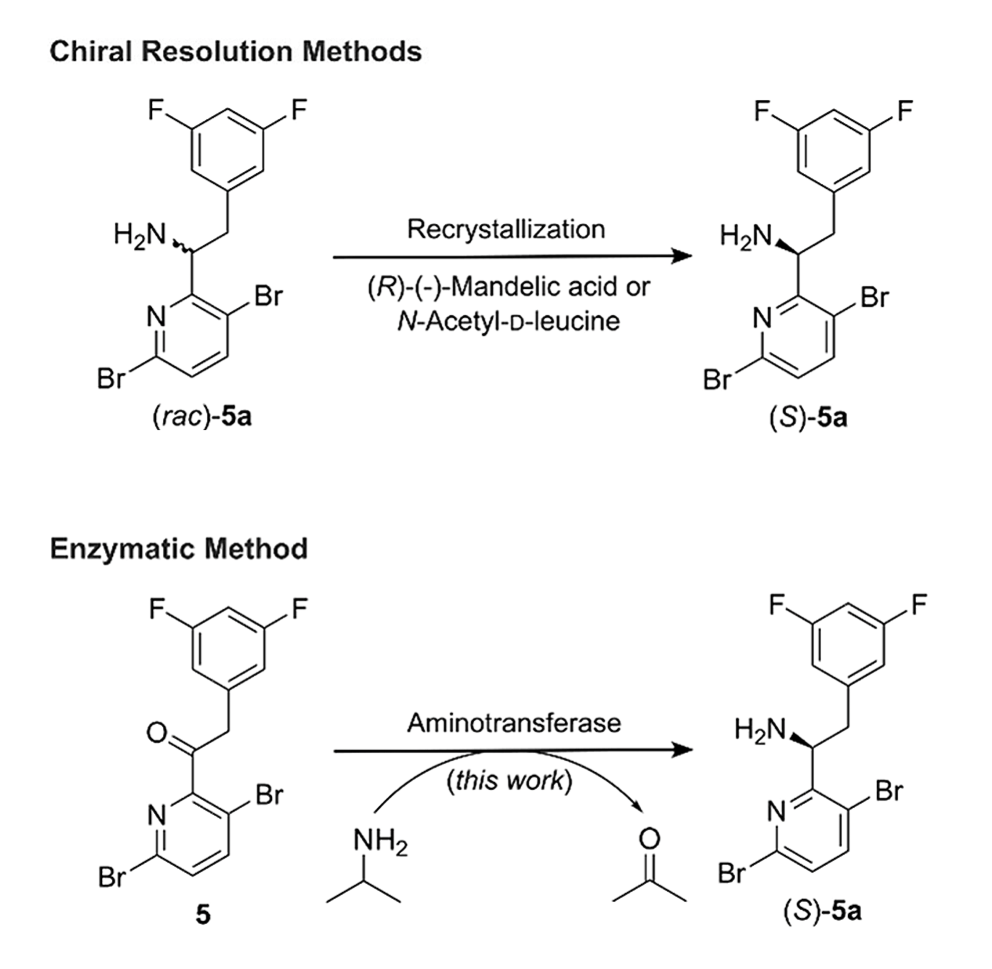
The two routes to the chiral core. Top: the established approach — build the racemate then conduct a chiral resolution to purify the desired enantiomer. Bottom: a single aminotransferase step delivers the (S)-enantiomer directly from ketone 5, using isopropylamine as a cheap amine donor.
An in-house panel of more than 400 aminotransferases was screened for activity against ketone 5; however, no ATA was identified. A survey of the literature and computational modelling placed ketone 5 among the most sterically hindered substrates ever attempted for an ATA process.
What we did observe in the screening data was several ATAs that were able to convert the structurally related ketones 6 and 7, which lack one or both of the bromine substituents on the pyridyl ring. No enzyme displayed activity on ketone 8, carrying a single 5-Br substituent ortho to the reacting ketone, identifying this motif as the specific obstruction for ATA-mediated transamination.
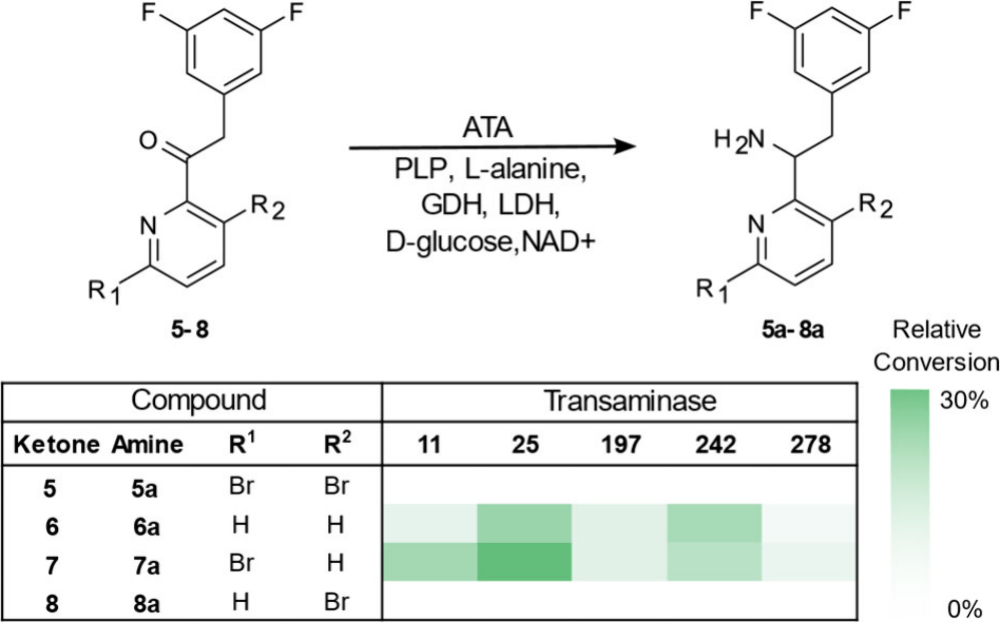
The enzyme panel showed no activity towards target ketone 5 and ketone 8, carrying the same ortho-bromo motif, highlighted by a blank row across the panel. Ketones 6 and 7 show some conversion, with transaminase 25 showing the highest activity.
This promising activity led us to approach this evolution project in two stages: first, to unlock the ATA activity towards the di-brominated species; then to enhance the activity and substrate loading, making the enzyme process-ready.
Unlock substrate acceptance: rounds 1–4
We adopted a substrate-walking approach: TA25, a variant previously engineered from the Ruegeria sp. TM1040 ATA scaffold, gave the highest conversions of 6 and 7, and became the starting template. In each round, 14–24 positions were individually randomised using NNK degenerate codons, screened in 96-well plates as clarified cell lysate by UPLC. Beneficial mutations from each round were recombined, and the best variant carried forward.
| Round | Screening substrate / direction | Mutation(s) installed | Outcome |
|---|---|---|---|
| 1 | (rac)-8a, deamination | F152G | TA25.1 — low activity on monobrominated 8a |
| 2 | (rac)-8a, deamination | L59A | TA25.2 — first amination activity on target ketone 5; ~9% conversion |
| 3 | 5a, deamination | V88A, P423D | TA25.3 — ~20% conversion; activity now detectable in cell lysate |
| 4 | 5, amination | F168L, R420P | TA25.4 — six mutations; 31% conversion of 2.5 mM 5, >99% ee |
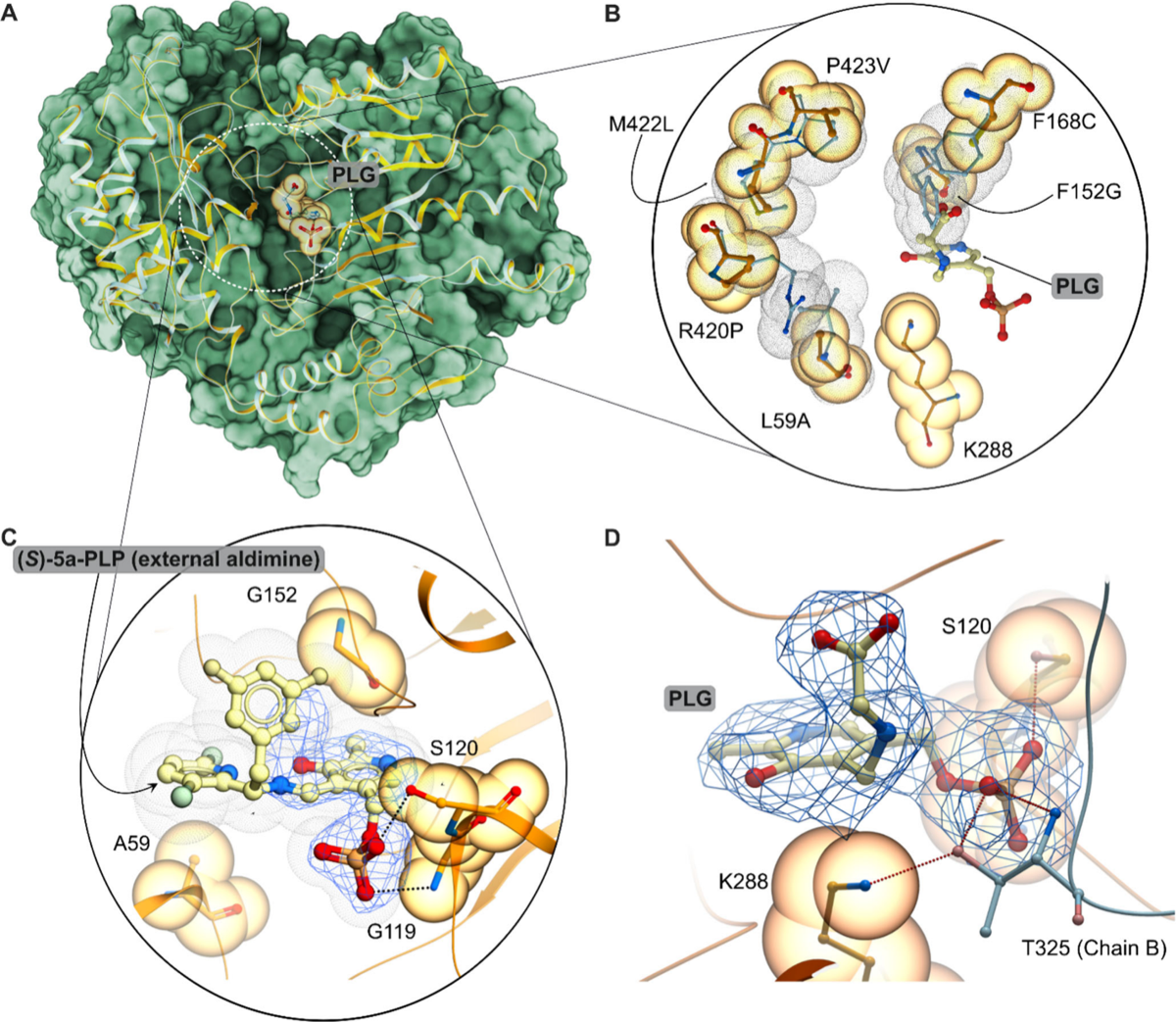
Two details of note: F152 had previously been shown to play a role in PLP cofactor binding, yet the F152G substitution proved essential to unlocking activity on the bulky amine. Conventional reasoning would be to ignore this position, but it was key. The L59A mutation in round 2 produced the first amination activity on the true target substrate, though at a level detectable only with purified protein.
By round 3 the activity was strong enough to screen in cell lysate; by round 4 it was strong enough to screen in the desired synthesis direction, using isopropylamine as the amine donor for its low cost, volatility and established use in manufacturing.
Four rounds of evolution took the programme from no detectable activity to 31% conversion of the target ketone with essentially complete stereocontrol.
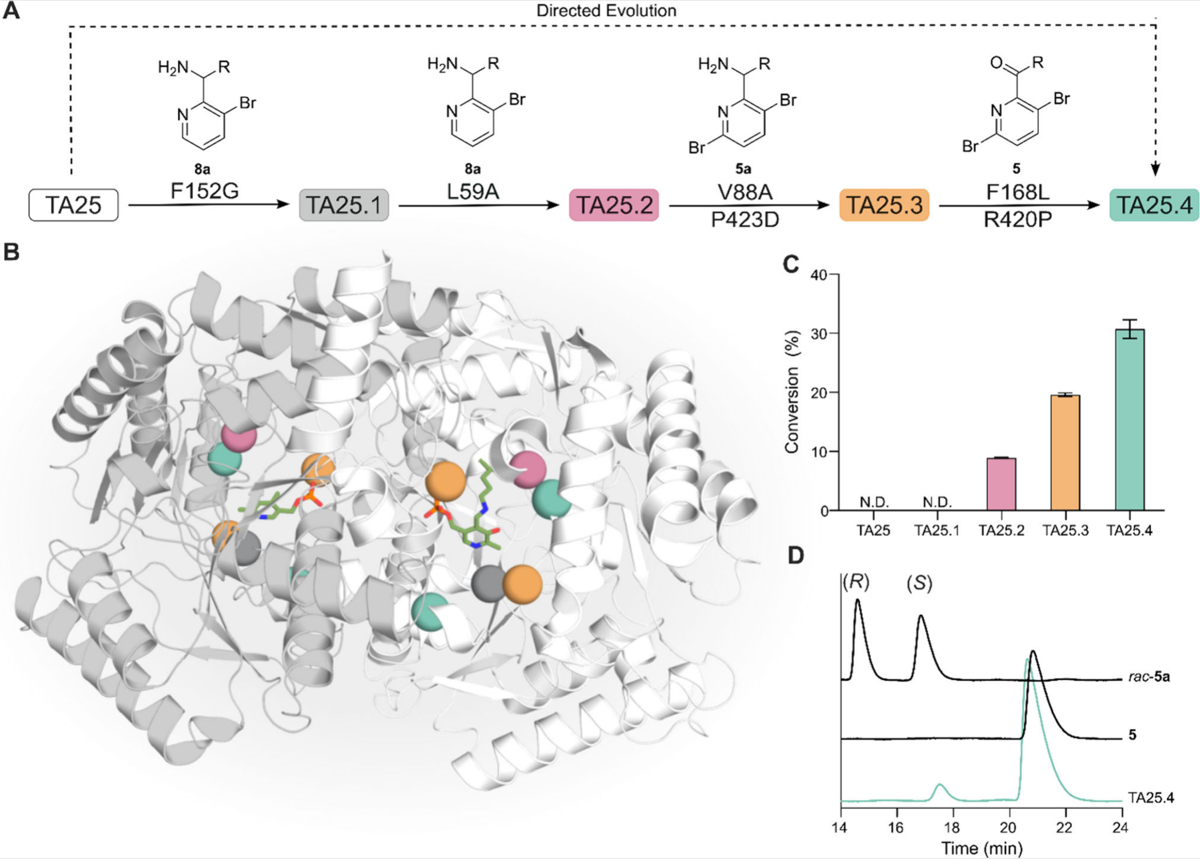
Rounds 1–4. (A) The evolutionary trajectory, showing the mutation installed at each round and the substrate used for screening — the substrate walk from monobrominated 8a to the target ketone 5. (B) The initial 6 mutated positions mapped onto the scaffold, clustered around the active site and PLP cofactor. (C) Conversion of 5 to (S)-5a at each step: not detected for TA25 and TA25.1, 31% for TA25.4 (2.5 mM 5, 20 µM enzyme, 24 h). (D) Chiral HPLC confirming the (S)-enantiomer is produced exclusively.
Unlock process: rounds 5–8
An enzyme that works at 2.5 mM in a 96-well plate is great as a proof of concept. However, making it a process is a separate engineering problem. We ran four further rounds of evolution, randomising 18–47 positions per round and screening more than 12,000 variants, with the reaction conditions progressively intensified at each round to increase the selection pressure:
- Substrate loading: 2.5 mM (1.0 g/L) → 20 mM (7.8 g/L) and beyond
- DMSO cosolvent: 20% → 40%, to address the substrate's poor solubility
- iPrNH₂ amine donor: 0.5 M → 0.75 M
The resulting variant, TA25.8, carries six further mutations (S86A, V158I, L168C, K171L, M422L, D423V), for a total of ten relative to the original TA25 scaffold. Positions 168 and 423 were further mutated from the initial variants, providing substantial gains in enzyme performance:
| TA25.4 | TA25.8 | |
|---|---|---|
| Conversion, 20 mM, 30 °C, 18 h | 8% | 86% |
| Conversion, 20 mM, 40 °C, 18 h | compromised | 94% |
| Melting temperature (Tm) | 57 °C | 65 °C |
| Tolerance at 50 mM loading | — | 65% conversion in 18 h |
Evolving an enzyme for co-solvent tolerance typically goes together with an increase in thermostability. TA25.8 displayed a significant increase in both thermostability and activity at elevated temperatures. Pushing the substrate loading even further, approaching 20 g/L loading dropped the overall conversion within the 18-hour reaction timeframe. Further rounds of evolution are currently being explored to make this transaminase-mediated reaction truly economically competitive with the established synthesis route.
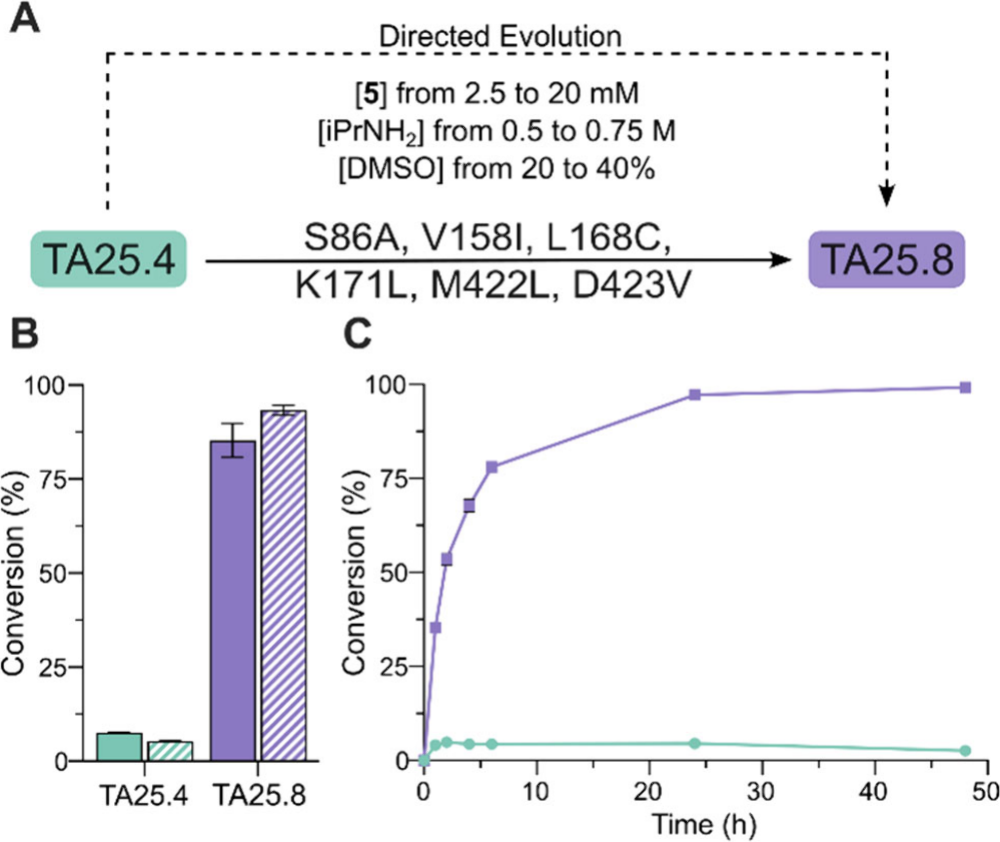
Rounds 5–8. (A) Six further mutations installed while substrate, amine donor and cosolvent concentrations were increased. (B) Conversion at 20 mM loading for TA25.4 and TA25.8, at 30 °C (solid) and 40 °C (hatched). (C) Time course at 40 °C: TA25.8 passes 75% within six hours and approaches full conversion by 24, while TA25.4 never leaves the baseline.
The result
A preparative-scale biotransformation using 0.25 mol% purified TA25.8 delivered 453 mg of lenacapavir precursor (S)-5a:
- 98% conversion
- 90% isolated yield
- >99% ee
The chiral core is produced directly, in the correct configuration, whilst avoiding the lengthy resolution step of the original synthesis.
What this demonstrates
Substrate walking gave us a way to engineer the enzyme even though it had no measurable activity on the target substrate. Starting with related substrates gave us activity we could screen for and improve, allowing us to evolve the enzyme towards the reaction we needed.
Once we had activity on the target, we spent a further four rounds improving performance at higher substrate loadings and under more demanding reaction conditions. This brought the enzyme closer to practical use, and work is ongoing to improve its performance further. Efforts are now underway to further increase substrate loading and translate the methodology to process scale with manufacturing partners.
Publication
Ford, G. J.; Taylor, C. J.; Hutton, A. E.; Birmingham, W. R.; Zhao, F.; Xu, Z.; Finnigan, W.; Ortmayer, M.; Levy, C. W.; Dunstan, M. S.; Crawshaw, R.; Rowles, I.; Green, A. P.; Turner, N. J. Biocatalytic Production of a Key Chiral Intermediate of the HIV Capsid Inhibitor Lenacapavir. J. Am. Chem. Soc. 2026, 148, 15384−15390. DOI: 10.1021/jacs.6c02519
Disyn Biotec Ltd. authors: G. J. Ford, Amy E. Hutton, Ian Rowles.
Figures adapted from the publication.
Facing a substrate no enzyme in your panel will touch?
We would like to see it. Get in touch to discuss your enzyme engineering challenge.
Contact Us